Spitsbergen, Northeast Greenland & Scoresby Sund, Including Long Hikes
The Spitsbergen and Northeast Greenland cruise sails waters filled with breath-taking scenery. The expedition passes through areas that are home to seals, seabirds, whales, and polar bears, topped off with nighttime viewing of the Northern Lights.
Long Hikes: -
Long hikes are for groups of 24 passengers maximum, accompanied by two armed expedition staff and a Zodiac that will sail ahead to watch for polar bears along the shoreline. Passengers who join this activity should have the willingness and ability to walk at least 15 km (9 miles) in semi-rough terrain that includes shorelines, tundra, low hills, and river crossings. Walks will take around six hours from start to finish, rest times included. We will walk at a modest pace and not cross any alpine terrain. Passengers who do not take part in long walks will have a landing in the morning at the start point of the walk, then sail to the end point of the walk for their second landing in the afternoon.
Highlights
• Long Hikes - Venture far into the wild Arctic backcountry, exploring a variety of rugged terrain on an exhilarating hike that will give you the true expedition experience.
• Photo Workshop - On select voyages, professional photographers will help you get the most out of your personal camera equipment
• Cape Hofmann Halvø - Bordered by huge dark mountains, Cape Hofmann Halvø (Peninsula) deep inside Scoresby Sund, is a Greenlandic cruise must-visit for those seeking out spectacular Arctic landscapes.
You touch down in Longyearbyen, the administrative center of Spitsbergen, the largest island of the Svalbard archipelago. Enjoy strolling around this former mining town, whose parish church and Svalbard Museum make for fascinating attractions. Though the countryside appears stark, more than a hundred species of plant have been recorded in it. In the early evening the ship sails out of Isfjorden, where you might spot the first minke whale of your voyage.
Sailing to Raudfjorden, on the north coast of Spitsbergen, you take in an expansive fjord spilling with glaciers – and maybe even visited by ringed and bearded seals. The cliffs and shoreline of this fjord also support thriving seabird colonies, rich vegetation, and the possibility of polar bears.
You may eventually see the jagged edge of the east Greenland sea ice flashing into sight ahead, depending on the conditions. Keep watch for whales and migrating seabirds here.
As you approach Greenland, you may sail through the sea ice into Foster Bay and land at Myggebugten. Beyond the old hunters’ hut (where Norwegian trappers hunted for polar bear and Arctic fox in the first half of the 20th century), there is a sprawling tundra populated by musk oxen, with geese floating the small lakes. From here you sail through Kaiser Franz Josef Fjord, surrounded by towering mountains and bright interior icebergs. An alternate route is Sofia Sound, a narrower waterway.
For those who choose to attend, we have our first long walk (6-7 hours) of the voyage today. We start at Myggbukta station and head into Badlanddal, then turn south to Fangsthytte near Kap Bennet. A Zodiac will sail ahead of the walking party and parallel to the coast to watch out for bears.
You arrive at Teufelschloss (Devil’s Castle), a mountain with layered geology. On the other side of the fjord is Blomsterbugt and the intended landing site. In the afternoon you head into Antarctic Sound, where you find the islands of Ruth, Maria, and Ella. Maria is the most likely spot for a landing.
In the morning you enter Segelsällskapets Fjord, with the streaked slopes of the Berzelius Mountains bordering the north side. You land on the south shore, where ancient sedimentary formations lie right at your feet. A hike takes you near a small lake with good chances to see musk oxen, Arctic hares, and ptarmigans. In the afternoon the ship ventures into Alpefjord, aptly named for the spire-like peaks that thrust up around it. You may then embark on a Zodiac cruise around Gully Glacier, which once blocked access to the interior of these waters. Continuing deep into the fjord, you experience a definitive Greenland adventure.
The first half of the day you spend in Antarctic Havn, an extensive valley where you can spot groups of musk oxen. At this time of year, the sparse vegetation is dressed in the fiery colors of autumn.
Today you reach Scoresbysund, sailing along the glaciated Boons Kyst. You may also enjoy a Zodiac cruise past one of the glacier fronts, along with a visit to the basalt columns and ice formations of Vikingebugt.
In the afternoon, we plan to sail by the east coast of Milne Land among a multitude of giant icebergs. If we can also land at Charcot Havn, we will make a walk to the Charcot Glacier. We will then continue by Bjørneør and sail into Øfjord, where we might also make a landing.
The goal is a Zodiac cruise near Sorte Ø, surrounded by icebergs. Their austere blue-white contrasts sharply with the sediment slopes nearby. The afternoon plan is to sail through the northern parts of Røde Fjord and into Harefjord, with the chance to see musk oxen and warm autumnal foliage.
In the morning you encounter colossal icebergs, some over 100 meters (328 feet) high and more than a kilometer (.62 mile) long. Most of them are grounded, as the fjord is only about 400 meters deep (1,312 feet). You then land near Sydkap, with fine views of Hall Bredning and a good shot of seeing Arctic hares.
Today’s long walk goes from Sydkap to Nordøstbugt (12 km, 7.5 miles to the northeast), where the river coming from Holger Danskes Briller flows into the sea. We plan to walk south along the shore to Satakajik, seeing whale vertebrae and the remains of Thule summer houses. Passengers who opt out of the long walking group will join us at this location for their second excursion of the day.
Today you make a tundra landing on Liverpool Land, in Hurry Inlet. The afternoon stop is Ittoqqortoormiit, the largest settlement in Scoresbysund at about five hundred inhabitants. At the post office you can buy stamps for your postcards, or just stroll around to see the sled dogs and drying skins of seals and musk oxen. In the afternoon you sail south, passing the picturesque landscapes of the Blosseville Coast.
A sea day grants you the opportunity to spot whales and seabirds – and at night, the magical northern lights.
Every adventure, no matter how grand, must eventually come to an end. You disembark in Akureyri, where on request you can transfer (T) by chartered bus (a six-hour drive that you must book in advance) to the bus stop Harpa Concert Hall and Conference Centre at Austurbakki, Reykjavík, taking home memories that will accompany you wherever your next adventure lies.
Itineraries are subject to change.
|
Book now |

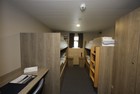
Quadruple Porthole
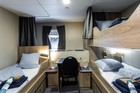
Triple Porthole
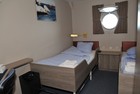
Twin Porthole
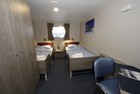
Twin Window
Twin Deluxe
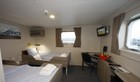
Superior
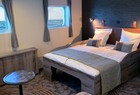
|
Book now |
Quadruple Porthole

Triple Porthole

Twin Porthole

Twin Window

Twin Deluxe

Superior

Junior Suite

Grand Suite with Private Balcony

|
Book now |
Quadruple Porthole
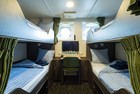
Triple Porthole
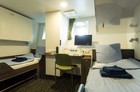
Twin Porthole
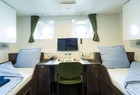
Twin Window
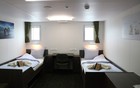
Twin Deluxe
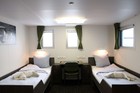
Superior
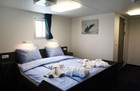
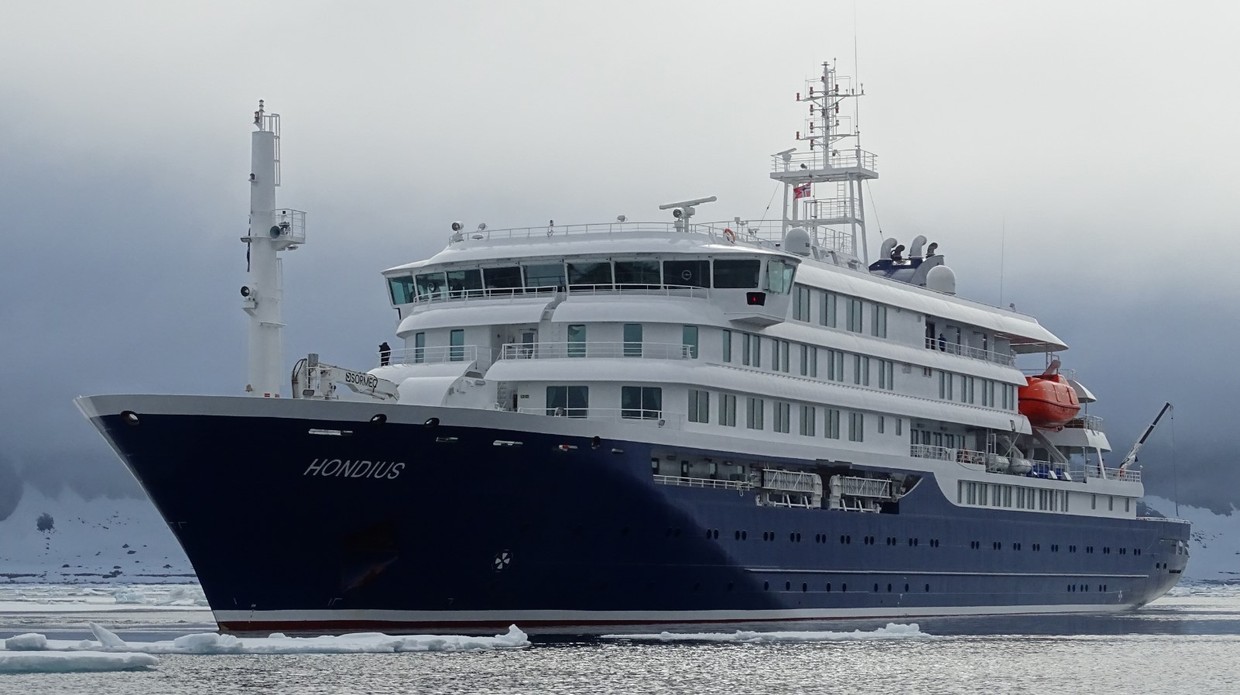
Vessel Type: Polar Class Expedition Ship
Length: 107.6 metres
Passenger Capacity: 170
Built: 2019
Hondius is a purpose-built Polar Class 6 expedition ship designed to operate safely and efficiently in the Arctic and Antarctica. Its ice-strengthened hull, advanced navigation systems, and powerful twin engines support fast repositioning and reliable performance in challenging polar conditions. Interiors follow a clean, mid-century modern style, with accommodation for 170 guests across a wide range of cabin types, from suites with balconies to porthole cabins for groups. Public spaces include an expansive observation lounge and a dedicated lecture room used for workshops and briefings, reinforcing the vessel’s focus on education and discovery rather than traditional cruise entertainment.
The ship is engineered for low environmental impact, using modern power management, LED lighting, and biodegradable materials. Shore access is prioritised through two gangways, an indoor Zodiac boarding area, and a large fleet of rigid-hull inflatables that support quick landings and near-shore exploration. With 70 crew, guides, and staff on board, Hondius offers the comfort of a well-run hotel while maintaining the flexibility required for wildlife encounters, shifting ice, and rapidly changing weather, ensuring maximum time in the field and minimal time at sea.


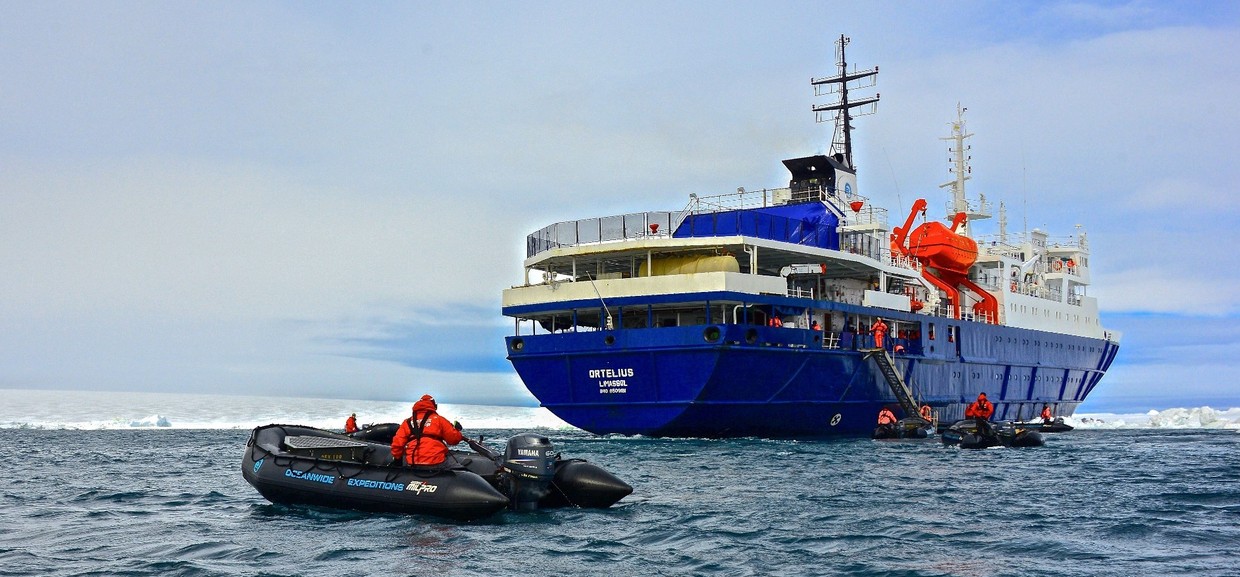
Vessel Type: Expediton
Length: 91m
Passenger Capacity: 108-123
Built / Refurbished : 1989 / 2015
Ortelius is a fully ice-strengthened Polar Class UL1 vessel built for demanding expeditions in one-year and multi-year sea ice. Originally constructed in 1989 for the Russian Academy of Science, its robust engineering and wide open-deck spaces make it well suited to deep-field exploration in the Arctic and Antarctica. The ship carries 108 passengers and operates with a substantial team of nautical crew, hotel staff, expedition leaders, and lecturers, supported by a fleet of ten Zodiacs for frequent shore landings and wildlife access. Interiors are functional and comfortable, offering standard hotel amenities alongside a lecture room and bar.
The vessel is designed for maximum time ashore and flexible routing, prioritising nature observation over traditional cruise programming. Some cabins may have partially obstructed views due to structural requirements, but the best vistas are always outside on deck or from the bridge. Ortelius offers stable performance, reliable ice navigation, and a straightforward, expedition-focused environment, making it a strong choice for travellers who want direct contact with polar landscapes without unnecessary embellishment.


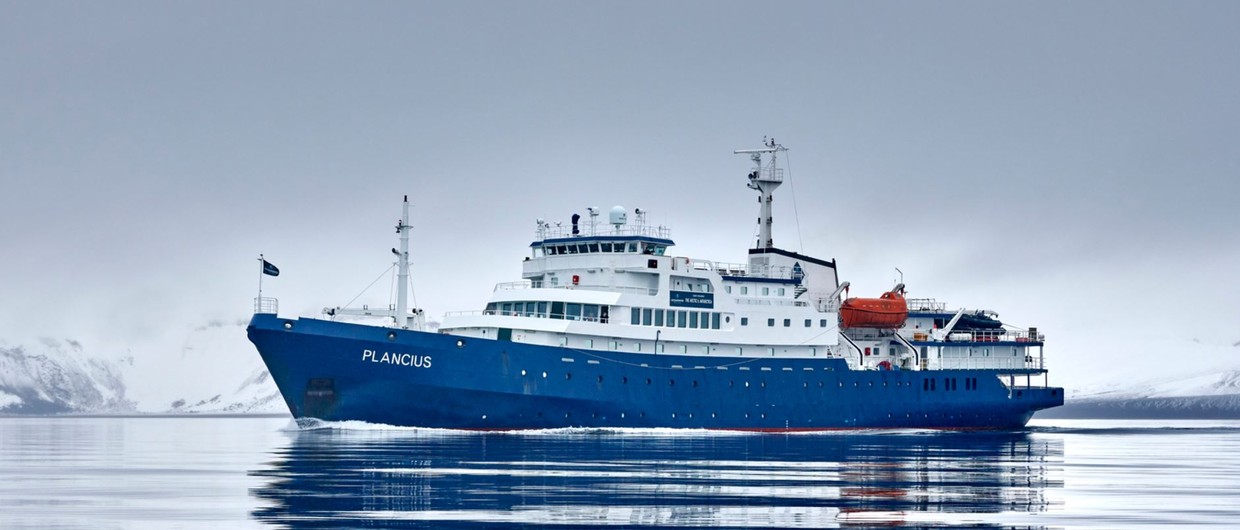
Vessel Type: Expedition
Length: 89 metres
Passenger Capacity: 108 - 116
Built / refurbished: 1976 / 2009
Plancius is an ice-strengthened expedition ship purpose-built for oceanographic work and later rebuilt for passenger exploration, giving it a solid, capable feel that suits remote polar travel. Its diesel-electric propulsion keeps vibration low, while wide open decks, a walk-around viewing level, and a large observation lounge support long hours of wildlife watching. Cabins are simple, functional, and consistent in layout, all with private facilities, while shared spaces such as the lecture room and bar-lounge form the centre of the ship’s educational and social life.
The vessel carries 108 passengers and a full expedition team, supported by a large, international crew that maintains steady operations even in challenging conditions. Zodiac capacity and dual gangways ensure efficient landings, maximising time ashore throughout Antarctica and the Arctic. Plancius is not styled as a luxury ship; its value lies in reliability, stability, and an expedition-first approach that prioritises learning, terrain access, and time in the field.


Inclusions
• Voyage in selected accommodation category
• All meals while on board the ship
• Coffee and Tea while on board
• All shore excursions and landings by zodiac as per the itinerary
• Lectures held on board by Expedition Team and naturalists
• Port Charges/Taxes
• Comprehensive Pre-departure materials
• Free internet (1.5 GB of free internet connectivity per day)
• Free use of rubber boots and snowshoes
Exclusions
• International and domestic airfares whether commercial or charter
• Pre and Post-voyage accommodation
• Passport and visa costs if applicable
• Travel insurance including medical evacuation cover
• Beverages not listed in inclusions
• Any items of a personal nature including any medical costs incurred on board
• Meals when not on board the ship
• Gratuities (Recommended USD$15 per passenger per day)

Our Associates Include


