East Greenland - Scoresby Sund - Iceland, Aurora Borealis, Fly & Sail
Sail through Earth’s largest fjord system on a historic three-masted vessel, getting the chance to encounter exotic Arctic wildlife like musk oxen and Arctic hares under the enchanting aurora borealis. Greenland whales may also appear between landing sites, where we will enjoy enormous icebergs, ancient Thule settlements, and scenic shoreline hikes.
Highlights
• Sailing among the glaciers
• Inuit neighborhood of yesteryear
• The tundra of Jameson Land
• Settlement at Scoresbysund
You arrive by chartered plane from Keflavik and land at Constable Pynt, the airfield at the head of Hurry Inlet. This area is known for its remarkably rich geological history.
Enjoy the sights as we sail the glaciated Volquart Boons Coast. Here you may set out on a Zodiac cruise along one of the shoreline glacier fronts, with your first activity near Månegletcher or Vikingebugt.
We sail by the east coast of Milne Land among a multitude of giant icebergs. If we can also land at Charcot Havn, we will make a walk to the Charcot Glacier before continuing by the Bjørneør and sail to Øfjord.
Today marks a visit to the east entrance of one of the most impressive fjords in the world: Ø Fjord is almost 40 nautical miles long (74 km, 46 miles), with mountains on each side up to 2,000 meters high (6,562 feet), and icebergs that drift over depths of more than 1,000 meters (3,281 feet). The aim is to land at Jyttehavn and hike the tundra in mythic surroundings. We may also sail into Harefjord, Rypefjord, and Rödefjord, walking into C. Hoffmanhalvöya and on Storö. We will then land near Sydkap, where you can see colossal icebergs, some of them over 100 meters (328 feet) high and more than a kilometer long (.62 mile). Most of these bergs are grounded, as the fjord is only about 400 meters deep (1,312 feet). At Sakatajik we can also view the remains of Thule winter houses. As many as twenty people lived here once, hunting Greenland whales and building houses out of their vertebrae.
At the western shores of Jameson Land lies a vast tundra with grazing musk oxen. We will try to make a landing on one of the areas, such as Tyskit Nunat, remembering Alfred Wegener’s efforts to cross Vandreblokken. We may also visit Kap Hooker or a lovely lagoon west of Kap Stewart.
Today’s stop is Ittoqqortoormiit, the largest settlement in Scoresbysund at about five hundred inhabitants. At the post office you can buy stamps for your postcards or just stroll around to see the sled dogs and drying skins of seals and musk oxen.
If there is not too much cloud cover, you might enjoy the magical lightshow of the aurora borealis today.
We disembark in the Icelandic town of Akureyri, taking home memories that will accompany us wherever the next adventure lies. If requested, you can take a chartered bus (six-hour drive) to Reykjavik.
End of trip
This trip concludes with a crossing of the Denmark Strait. Since Northern Atlantic weather can be rough in October, the captain will decide when to depart East Greenland to make for the most pleasant crossing.
|
Book now |
Triple Private
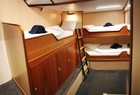
Twin Private Inside

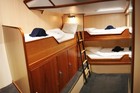
Twin Private Porthole
Vessel Type: Expedition Yacht
Length: 49.5 metres
Passenger Capacity: 33
Built / refurbished: 1900's / 1994 / 2011
Rembrandt van Rijn is a three-masted schooner with origins as a 1947 herring lugger, later rebuilt for passenger voyages and fully modernised to meet current safety standards. Its compact size, shallow draft, and renewed navigation systems make it well suited to navigating the channels, fjords, and smaller islands of the Arctic. Open deck space supports uninterrupted viewing under sail or engine power, while Zodiacs extend access to remote shorelines. Cabins are simple and functional, all with private facilities, arranged across triple, twin inside, and twin porthole layouts.
The ship carries a maximum of 33 passengers with a small, experienced crew and two guides, creating an informal, close-knit environment. Daily landings focus on wildlife, geology, and natural history, with itineraries adjusted to conditions for maximum time ashore. Meals are straightforward and served buffet-style, and the vessel maintains an expedition-first profile without luxury positioning. Rembrandt van Rijn’s advantage lies in scale: the ability to move quietly, land efficiently, and create an intimate sailing-based expedition experience.


Inclusions
• Voyage in selected accommodation category
• All meals while on board the ship
• Coffee and Tea while on board
• All shore excursions and landings by zodiac as per the itinerary
• Lectures held on board by Expedition Team and naturalists
• Port Charges/Taxes
• Comprehensive Pre-departure materials
• Free internet (1.5 GB of free internet connectivity per day)
• Free use of rubber boots and snowshoes
• Transfer supplement for bus shuttle between Akureyri (ship) and bus stop Harpa Concert Hall and Conference Centre at Austurbakki, Reykjavik (6 hours).
Exclusions
• International and domestic airfares whether commercial or charter
• Pre and Post-voyage accommodation
• Passport and visa costs if applicable
• Travel insurance including medical evacuation cover
• Beverages not listed in inclusions
• Any items of a personal nature including any medical costs incurred on board
• Meals when not on board the ship
• Gratuities (Recommended USD$15 per passenger per day)

 Yacht
Yacht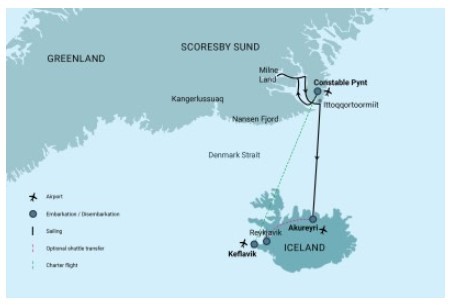
Our Associates Include


